Sunday, November 23, 2014

I scream, you scream, we all scream for Keanu Reeves

This week it's time to embrace the weirdness: narcolepsy, denim jackets, the one-two punch that is River Phoenix and Keanu Reeves, and Idaho.

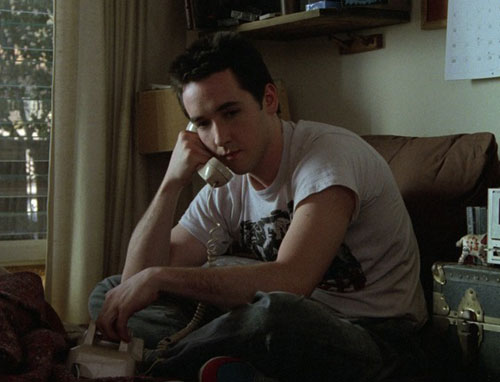
I'm referring, of course, to My Own Private Idaho (1991). Directed by Gus Van Sant, this is a movie that you'd swear makes you feel the chill through your windbreaker.

Gorgeous.
Phoenix and Reeves play Mike and Scott, two friends who hustle for cash and sleep, in Mike's case, anywhere and everywhere: gardens, the back of motorcycles, empty roads. His narcolepsy is the complicating element in his pursuit to find his mother, a journey which leads them from Idaho to Italy, and back again.


As Mike and Scott orbit around each other among bards and blank landscapes, the film becomes steadily more dream-like. It's just not a dream you've ever had before, or maybe one you've had so many times that you've forgotten how it ends. 

Does this look like a face to you?
Part of this is indubitably due to Gus Van Sant, whose track record for strangeness is high--he also directed Elephant, and, funnily enough, Good Will Hunting--but without Phoenix I feel the effect would be incomplete. 

His narration and unrequited love for Scott guide the film into what it is: a meditation, a novel, and a weird, strange masterpiece.


To sum up, in My Own Private Idaho not much happens, but what does happen--well, it's pretty interesting. So check it out. Embrace the weirdness.

Till next week.

Saturday, November 8, 2014

Whiplash


Whiplash is the kind of film that you sit through white-knuckled, waiting to know what happens next. Miles Teller plays Andrew Neyman, a young drummer wunderkid--or, depending on the moment, not so wondrous. His ambition is to be the next Charlie Parker.


What follows is a chamber piece about what's inside of Andrew's head. We follow him as he is discovered by his college's most famous jazz director, Terence Fletcher, played by J.K. Simmons. It is not so much a discovery as a revealing, a veil lifted. 


Terence is mercurial and demanding and thrilling. Even as he tears Andrew down, there is a sense that his means will be justified by his ends. The push-pull relationship, heightened by the soundtrack,  translates into drama calculated to surprise.

There's no doubt that Whiplash is a good movie. Better, if you've ever played percussion. And yet there is one glaring flaw that cannot be overlooked: that is, there are no women in this film.


Of course there are actresses. There is an orchestra player and a lawyer and even a girlfriend. But there are no women. At no point are there two female people onscreen at the same time, much less speaking to one another. Andrew's mother is denoted by her absence, his girlfriend by her silence.

It is as though, encased in his own drama, there is no room in Andrew's head for much of anything besides Terence and his drum set. Fine. This is, after all, a movie about a boy.

But aren't we tired of art house films about boys?


Aren't there better things we could be spending our time on? If boys, why this type of story, with this perspective? Do we really have to accept this kind of under-the-table misogyny in our art? Can it even be art if it ignores half the audience? For that matter, where are the men? Terence isn't one. If it's a coming-of-age film there are no models, no real-life Charlie Parkers. There is no final exam, no test, no pass.

Leaving the theater, I wondered if in this alternate universe Andrew Neyman would ever grow up. Maybe. Maybe not. It doesn't matter. Whiplash could have been a great movie, but instead it settled for being a good one.

Saturday, October 25, 2014

It Felt Like Love

Fourteen-year-old girls are mysterious creatures. No one knows this more so than Eliza Hittman, whose film It Felt Like Love was released at Sundance in 2013.

From the top there is a spareness to the visuals. As the main character, Lila, walks along the beach in pursuit of her best friend Chiara and Chiara's boyfriend, we can track her but not her surroundings.


Backgrounded by scenes of a forgotten Brooklyn, Lila and Chiara spend their time taking the bus to the beach, where they suntan (or, Lila's case, burn) and track things with their eyes. The one true excitement in their lives are their boyfriends (or, in Lila's case, the lack of one).

It's a quiet film.


It's only when Lila meets another, older boy--Sammy--that things change. With it comes a shift, a darkening, a molting. Lila begins wearing makeup and hanging around Sammy's work, begins buying groceries in another town just to say that she was in the area, just to say hi.


It Felt Like Love transforms into a fantasy. Here are the clockwork girls, here are the boys in blue, here are the fields we've come to know. Here is the song I love the most.


As the scenes begin to take on a sense of dissolution and Lila a haunted, doll-like quality, it can be difficult to tell if she is performing with us or at us. Like Degas' Little Dancer Aged Fourteen, she stands stock still when she should move, permanently adolescent until she isn't anymore.

What I love about this movie is when she does come of age, it is of her own choosing. No one--not her father, not Chiara, not Sammy--controls Lila's fate. Except Lila.


That's the hidden truth about fourteen-year-old girls that Eliza Hittman understands: that they, too, are powerful.

Tuesday, September 30, 2014

Crazymaking

What they never tell you in therapy school* is that you can be crazy without being crazy. Case in point: Bradley Cooper in the Silver Linings Playbook.

Yes, DeSean Jackson is in the house.
In the last two weeks I decided that the start of football season was an apt time to review a movie about the sport. As you might have guessed from the above image, Silver Linings is that movie.

But this is not a film just about football. No--it's about obsession, about wanting something so badly it blinds you to what is right in front of your eyes.

Released in 2012 just in time for Oscar season, the film features Cooper as Pat Solatano, a man in a mental hospital for assaulting his wife's lover. He suffers from bipolar disorder and a really, really bad  motto: Excelsior, meaning ... what does it mean?

Tiffany Maxwell, a young widow recently fired from her job for sleeping with the whole office, is the woman he meets after being released.

Jennifer Lawrence.
It's difficult to tell who is more crazy. I mean, when they meet at a diner he orders Raisin Bran and she orders tea.

For the record: Raisin Bran, every time.
Pat, still in love with his ex-wife, resists this premise. He thinks that she is the crazier one, until he's forced to acknowledge that in the bundle of insanity that is Pat and Pat's family and Pat's life, Tiffany Maxwell may be the only thing about it that makes sense.

Tiffany has her own life and her own persona and yet she's still willing to reach out and ask for what she wants, in addition to indulging the insanity that is football fandom. Listen to this video and tell me that this is not a girl who has thought through her argument:


That said, having seen it several times what keeps me coming back to Silver Linings is not actually the football or the crazy '80s style dance routines. No. What I like about this film is its acknowledgement of the obvious: that we are all crazy. We are crazy in love, we are crazy in fandom, and we are just plain crazy.

And that's okay.

EXCELSIOR.

Wednesday, September 17, 2014

How to say anything

Ladies and gentlemen, John Cusack
Sometimes there's no good way to say what you want to say. Or the meaning gets lost in translation, even when you try to translate.

Say Anything... is not a movie that has this problem. Released in 1989, it has since turned into one of the great cult success stories of the eighties. The film starts with John Cusack at the height of his powers as hyper-articulate slacker Lloyd Dobler, who happens to be in love/lust with a girl named Diane Court. Even the names in this movie have impeccable grammar.

Ione Skye, aka Diane Court
When Diane actually agrees to go out with Lloyd everyone is surprised, inspiring what I will argue is the greatest bit of dialogue between three teenage girls ever filmed:

DC: Hey, I know this is a strange thing to say, but maybe Diane Court really likes Lloyd.
COREY: If you were Diane Court, would you honestly fall for Lloyd? [pause] Yeah.
DC: Yeah!
REBECCA: Yeah.

I mean, feel free to fight me on this, but I feel I have a pretty solid case.


So. They go out. It's a date, it's a scam--whatever it is, it's magical. It's that instant connection based on romantic gestures and charm and incredible attraction. It's great.

It's also a movie.

By which I mean that it misses the mark, in terms of brutal honesty. It doesn't say just anything; instead it says very specific things about very specific circumstances. Like the fact that Lloyd doesn't want to buy anything, sell anything, or process anything as a career. And the fact that Diane has a theory of convergence. And the fact that jukeboxes cost about 9000 dollars. (Or did, anyway. This was the late eighties.)

There's something really unbelievable about all of this. For one thing, real relationships aren't montages. They require effort, and the willingness to have difficult conversations. For all their articulation sometimes when I watch Lloyd and Diane talk I am not sure they are really saying anything after all. They are talking to each other, not with each other.

That's the problem, isn't it? When you talk to someone, you aren't listening to them.


What brings me back to this movie over and over again isn't the infatuation or Lloyd's boombox. It's the last scene, when they are just sitting quietly on a plane, waiting for a sound.

*

Sunday, September 7, 2014

The Hanks Conundrum

What happened to the trope of women booksellers? It feels like one day we all just woke up and instead of female leads shelving books in libraries and male leads drafting on architecture tables we had something called "Marketing Associate."

Of course, we all know what happened--

It was the 2000s.
--but that doesn't mean we have to give up the ghost entirely.

You've Got Mail (1998) was practically formed off the combination. Kathleen Kelly, otherwise known as the inimitable Meg Ryan, is a bookseller about to go out of business when she meets Joe Fox (Tom Hanks). Her rival's son.

Except it turns out that they've already met -- on the internet.

Dial-up, yo
AOL Instant Messenger is the centerpiece of the movie, and the undoubted inspiration point. I can only imagine the buildup was similar to when that guy wrote that script for that film that was going to be "about Facebook."

What redeems the movie is the chemistry; Hanks in particular is as sharp and clever as he ever gets. But let's be honest. The man could have good chemistry with a sock.

Or some chairs.
It's not even the best Hanks-Ryan combo--that would be Sleepless in Seattle, which is too perfect to critique.

What You've Got Mail is, really, is an antique. I say this because it so perfectly captures a moment in time--the late '90s, when AOL was just starting to become a thing--that to look back on it is to look at something so perfectly comprehensive as to be absolute. I mean, people who were zero years old when You've Got Mail was released are now sixteen and watching it still feels like yesterday.

Like Cary Grant, it's aged well.


It does make me wonder: how will filmmakers portray Tinder? (A word which, though I am the target audience, I had to check the spelling of twice.) Will it be a romantic tale of two people connected by the mere swipe of a thumb, or will it be humdrum and pedestrian? I hope the former, because in fifteen years a lot changes.

Heart, though. That stays the same.

Friday, August 29, 2014

When You Cannot Possibly Do Anything Else

Do you know those weeks when you cannot possibly do anything else but the thing that you are doing?

This is one of those for me. I am moving to a familiar city for a new job--here's a nice announcement, if you are interested--which has entailed, in the past few days, all the things that moving usually entails, as well as all the goodbyes that starting a new venture usually entails.

So for this week there can be no new post.

No new post, but one coming soon. And the next, and the next. I'll leave you with this clip from 13 Going on 30 (2004). It's a fun one.


Coming up next week? Something--Hanksy.

Search This Blog